


Tools for Writers to Stay Organised
- DD Brady
- Feb 1
- 3 min read

By Des Brady

Writing is solitary, but a writing life is anything but simple. Between drafting, revising, submissions, deadlines, notes, research, and the constant drip of ideas, disorganisation can quietly kill momentum. I’ve learned—mostly the hard way—that staying organised isn’t about being rigid or hyper-productive. It’s about reducing friction.
Over time, I’ve built a system that supports my work rather than overwhelms it. Some tools stuck. Others didn’t. What follows isn’t a productivity manifesto—just an honest audit of what I use, why I use it, and what I’ve left behind.
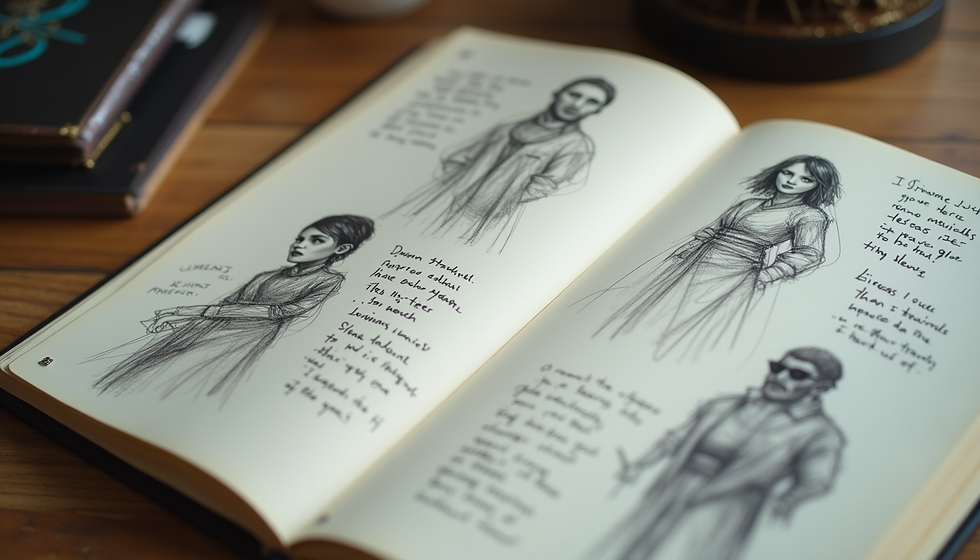
1. A Physical Notebook (Yes, Still)
Despite all the apps available, my most reliable tool is still a plain notebook. Not a beautiful one. Not colour-coded. Just functional. And messy.
I use it for:
Early story ideas
Character sketches
Scene fragments
Overheard lines of dialogue
Structural problems I’m trying to think through
There’s something about handwriting that slows the mind just enough to make thinking clearer. I don’t organise these notebooks meticulously—they’re messy, contradictory, and full of crossed-out nonsense. That’s the point. This is where uncertainty is allowed.
What I’ve ditched: trying to make my notebooks archival. They’re temporary thinking spaces, not sacred objects. But the interesting ideas that stand out among these notes, I transfer to my computer notes.
There they might sit and slowly develop, or they may jump into life as a great idea. Sometimes, I’ll turn this into a short story and, maybe, put this into a competition. Finally, a short story might just work in long form. I have quite a few of those on the backburner.
A Simple Folder System (Boring but Essential)
I keep a clean, predictable folder structure on my computer:
One folder per project
Subfolders for drafts, notes, submissions, and research
Clear file names with dates or version numbers
It’s not clever. It’s not aesthetic. But it prevents panic when I need to find something quickly—or when I return to a project months later.
What I ditched: overly clever naming systems. Consistency beats creativity here.
A Submissions Tracker (Low-Tech on Purpose)
Tracking submissions is where chaos used to creep in. I’ve tried apps, spreadsheets, and specialised platforms. What stuck was a very basic spreadsheet.
I track:
Title
Market
Date submitted
Response (if any)
Outcome
That’s it. No colour coding. No stats dashboards. The goal is clarity, not motivation through metrics.
What I ditched: constantly checking submission statuses. Once it’s logged, it’s out of my head.
Calendar Blocking (Lightly, Not Religiously)
I use a digital calendar to block writing time, but I keep it flexible. Writing doesn’t always respect rigid schedules, especially alongside work and life commitments.
Instead of daily word counts, I block:
Drafting sessions
Editing windows
Submission days
This helps me see my writing life as something that exists in real time, not as an abstract ambition.
What I ditched: guilt when a session doesn’t go as planned. Organisation should support creativity, not punish it.
Notes App for Capture, Not Storage and Photos as Triggers
I use a notes app on my phone purely as a capture tool. Ideas come while walking, driving, or half-awake at night. I jot them down and move on.
Once a week—or when a project demands it—I migrate anything useful into its proper home.
What I ditched: trying to build a “second brain.” I don’t need permanence everywhere. I need reliable collection and deliberate sorting.
Photos and stories, whether they are online or in other information sources (including old school newspapers), are constant sources of stories. Photos are particularly powerful as sources of stories as I’m a very visual person. The other source of inspiration is songs. Not necessarily the lyrics (which are copyright, so you need to watch out there) but for themes. Ideas. I wrote novel on the back of a single song that gave me inspiration.
What I’ve Learned Overall
The biggest organisational mistake I made early on was chasing the perfect system. The truth is, your tools should evolve with your work.
Organisation isn’t about control—it’s about trust. Trust that you’ll find what you need. Trust that ideas won’t disappear. Trust that you’re making space for the work that matters.
The best system is the one you stop thinking about.
Final Thought
Staying organised as a writer isn’t about becoming more efficient—it’s about becoming more present. When your tools fade into the background, your attention returns to the page. That’s where the real work happens.
If a tool makes you feel productive but keeps you from writing, it’s not serving you. Strip it back. Keep what helps. Ditch the rest.
Your future self will thank you.
Happy writing
Des Brady
Aussie Crime and Thriller Writer

Comments